Posts

Showing posts with the label Bible

Typical Evangelical Sermon

I’ve just finished listening to a sermon by Erwin Lutzer, at the  Word Of Life Florida Conference Center (January 28, 2018: “How to Die for the Glory of God”). It concerned our attitude towards our own death. I won’t attempt to transcribe it, or outline it. But I do want to say something about it, as it seems to me to be emblematic of evangelical sermons written today. It contains the chief elements necessary for a sermon to be “evangelical.” These are: Placing ultimate value on an individual’s grace God is Supreme Call to circle the wagons Reliance on cliche Showing the divide between the Saved and the Damned, the Christian and the...well, damned, using biblical evidence picked, chosen among many verses leaving out any that might show another viewpoint. Jesus is supremely valuable, says Lutzer. He says, “ My death is my win [my emphasis].” To live is Christ, to die is gain. --Philippians 1:21 The evangelical sees death as a win... his win. There is so ...

Am I A Christian?

Image
I’ve been asked if I am a Christian. I said that No, not in the way that most people think of the term. I wanted to say more--so much more--but felt that there wasn’t enough time and besides, I was too tired to get into it. So I’d like to get into it. When someone asks me Am I a Christian, I want to say Yes, but… or No, but… I also want to just say what someone wrote in a blog on Patheos (apologies but I cannot find the source) when she said that she was “a human being.” It would be nice to just sometimes leave it at that. I do and I don’t believe in the resurrection of Jesus. I do and don’t believe in his divinity. By that, I believe in the narratives (there are more than one) and their power and their truth. But I don’t understand those narratives to be some overarching historical artifact. Because I don’t feel that there is any overarching historical foundation to any narrative. In other words, there is only narrative. That is it. There is nothing beyond that. Nothing...

God, Music, Language, Art

Image
Given the notion of a creator God, it can easily be guessed that it--this creator-god--would communicate with its creation, yes? One might imagine a less collaborative deity, I suppose, one that just exists, theistically, and that was the view of many of our own founding fathers. That view, however, seems such a blind alley. A creator without the interplay, the teamwork, of its individual creations, that is just a stifling thought. So what would this communication be like? Would it be in language, in words, that men use? How could words work to convey the mesh of a creator’s inner-workings? Can language hold that much meaning? Even if so, the best language can do is to hold it within one language at one time. Anyone who has attempted the fool’s errand of translation knows how impossible it is. But I guess it is possible for a creator to speak in one language. Maybe he chose Hebrew, then Greek and Aramaic. But what of the native tribes out there? Where is their Bible? What of the ...

The Museum of the Bible

Image
The new Museum of the Bible  has officially opened in Washington, D.C. It does not proselytize (openly). It does not apparently teach Creationism. It seems to be fairly open about certain narratives that ended up being, shall we say, in disrepute (slavery, ahem). It attempts, in the words of one of the directors, to make the Bible “cool.” Nice location, right near where the Smithsonian sits, not far from the Mall, so it takes in the gravitas of a serious museum along with a near hand-holding with government. One might be forgiven for thinking the Green’s (the Hobby Lobby family and chief funders of the museum) are acting within the Dominionist ideology, which states that Christians (meaning evangelical Christians, not those of the baser mainstream denominations, thank you very much) must integrate themselves into government. Can you say, “theocracy”? There is likely not going to be an exhibit showing visitors how the Green family stole artifacts , and was fined $3 milli...

Leonard Cohen's Sufi Mysticism

Dance me to your beauty with a burning violin Dance me through the panic till I'm gathered safely in Lift me like an olive branch be my homeward dove And dance me to the end of love .-- Leonard Cohen and this made me think that this could easily be a Sufi poem, something like S uddenly the drunken sweetheart appeared out of my door. She drank a cup of ruby wine and sat by my side. Seeing and holding the lockets of her hair My face became all eyes, and my eyes all hands.-- Rumi [Translator: Shahram Shiva] Mary Blye Howe's book, Sitting With Sufis, instructs us that: "For the Sufi, Love is the path to God. Rumi tells us that only the person whose garment is 'rent by the violence of love' can be be wholly pure from covetousness and sin." And this love is not the "agape" love that protestants like to portray it as, or rather, it is and it isn't. Agape love is a general term, one that can also include the passion of a lo...

The Message Bible--A translator's conundrum

Image
“Poems are not perfect crimes. Too often, meaning is reduced to a feat of amateur detection which assumes that a poem is a kind of murder or a jewel theft, with a corpse, a hidden weapon, and a blueprint of the plumbing, all of which can be logically deduced by any Englishman with a large magnifying glass and credentials from Scotland Yard. But poems are not perfect crimes, for all their apparatus of passion, intention, and obsessive ingenuity in transforming fantasy into experience and experience into fantasy. Their procedure is vascular or sonal, rather than rational. They move like snails under a shell, carrying the coiled weight of their language over a sensitive paraphernalia of sticky horns and protoplasm in little bursts and thrusts, leaving the glistening accident of their chemistry behind them. Meaning is the trail of the snail.”--Ben Belitt “The translation of poetry can never exceed the enigma of it, and be true.” --Ben Belitt I’d like to discuss The Message Bib...

The Broken Bible

Image
In the Gospel of John, Jesus is executed on the Day of Preparation for Passover. As lambs went to the slaughter so Jesus went to the Cross. In Mark, he was executed on Passover. Fundamentalists have contorted their minds over this for centuries; all have convinced themselves that no error has been made, and no inconsistency presents itself. Well. Obviously there is a problem here, but only if you view the Gospels--the entire library of the Bible, really--as history, as recorded moments, verifiable through archaeology, and historical accounts. Something else seems to be going on in the Bible, but here we are in the 21st century and Christians still feel timorous discussing the possibility that the Bible is not history, and that many things contained within it simply did not happen. These fundamentalists fear that if people knew of the discrepancies held within the pages of the Bible, that people would run hither and yon, away from the preachings of the Good Book. What they fail...

The Processed Church

Image
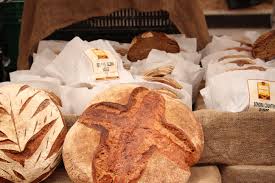
To process: the performing of a series of actions to change or preserve something. Michael Pollan’s documentary film series, Cooked , ends with the final episode on Earth, which describes the culinary act of fermentation. The penultimate episode dealt with Air, and mainly featured the baking of bread with an inspection of what process is involved with changing wheat kernels into flour. Previous episodes dealt with Fire and Water. To watch as food is changed from form to form, by the action of fire, or bacteria or yeast, or simply time, makes you aware of how far we have become separated from original methods of processing food. How we now substitute manufacturing processes in order to produce cheap packaged products that last a very long time on store shelves. We know we lose something for convenience, and for costs. What is that something? Maybe we hide something. Or substitute something for another. Is this a kind of game we play, a trick? A pretense? A loaf of genuin...